


Why Chicago's EV Revolution is Changing Apartment Living
Apartments with EV charging are becoming the hottest amenity in Chicago's rental market, and for good reason. With EV sales predicted to reach 40% by 2030 and over 60% by 2035, the demand for convenient charging solutions has never been higher.
Quick Guide to Finding EV-Friendly Apartments in Chicago:
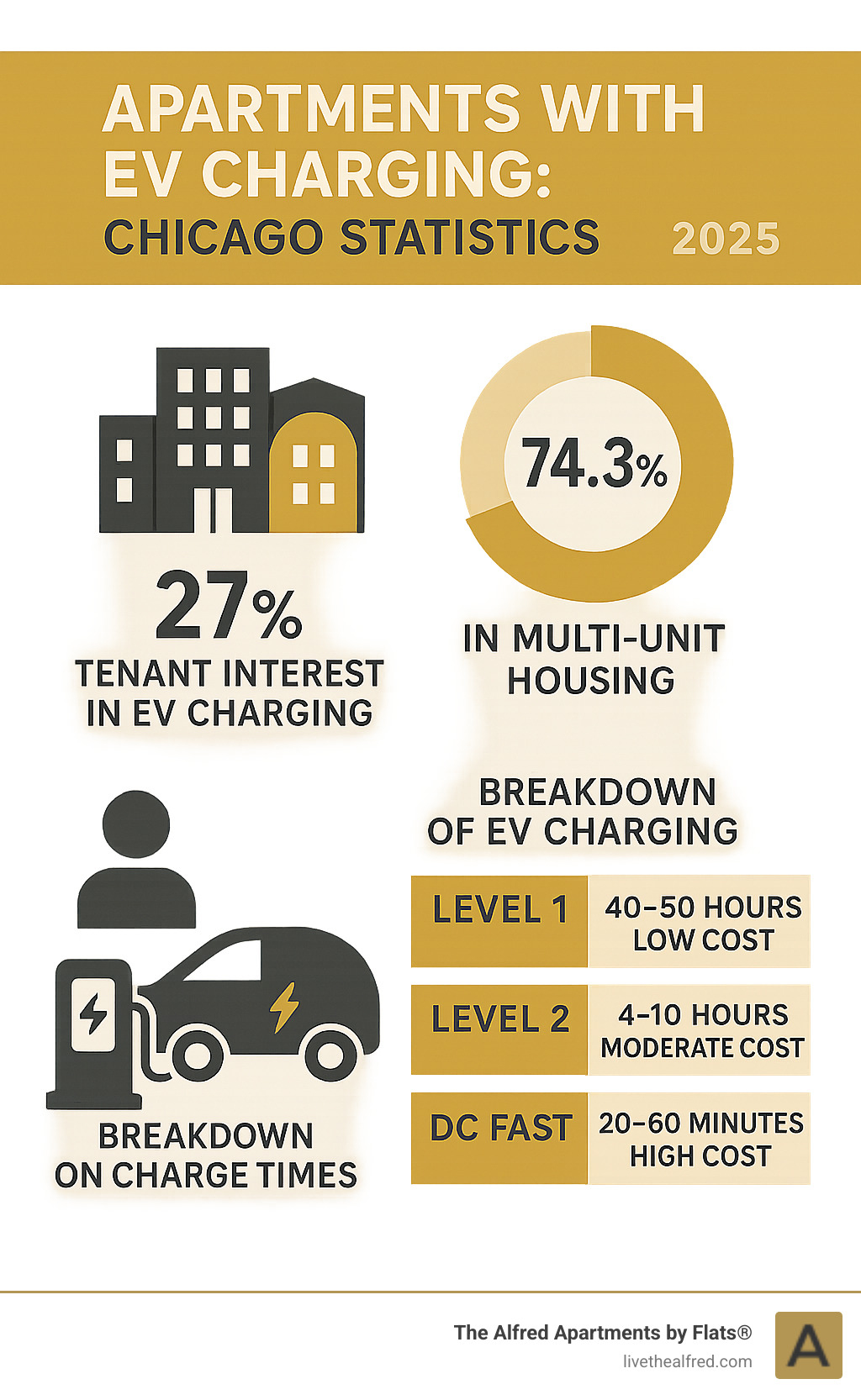
- Current Supply: Fewer than 5% of rental properties offer EV charging, but 27% of tenants want it
- Best Neighborhoods: River North, South Loop, and West Loop lead in EV-equipped buildings
- Charging Types: Most apartments offer Level 2 chargers (4-10 hour full charge)
- Cost Structure: Usually pay-per-use through apps like ChargePoint or monthly parking fees
- Key Questions: Ask about charger count, billing model, and future expansion plans
The numbers tell a compelling story. Over 80% of EV charging happens at home or work, making apartment charging a necessity rather than a luxury. Yet with only 5% of Chicago rental properties currently offering this amenity, finding the right building can feel like searching for a needle in a haystack.
This shortage creates a real problem for the 74.3% of Chicagoans who live in multi-unit housing. One California study found that 40% of EV shoppers postponed their purchase until they had reliable charging access, and shockingly, one in five EV buyers actually returned to gas cars due to charging inconvenience.
But here's the good news: Chicago's apartment market is rapidly evolving. New construction projects are increasingly including EV charging as standard, and forward-thinking landlords are retrofitting existing buildings to meet growing demand.
Why Apartments with EV Charging Are a Game-Changer for Chicago Renters
The shift toward apartments with EV charging represents more than just a trendy amenity—it's a fundamental change in how we think about urban living. For Chicago renters, these buildings offer benefits that extend far beyond simple convenience.
Consider this: 47% of millennials, 41% of Gen Zers, and 38% of Gen Xers plan to purchase an EV as their next vehicle. This demographic shift is forcing property managers to rethink their amenity packages. Buildings that once competed on gym quality or rooftop decks now find themselves racing to install charging infrastructure.
From a tenant retention perspective, the impact is remarkable. Properties with EV charging report higher resident satisfaction and longer lease renewals. As one industry insider put it, "EV charging is as required as having a gym. It's beyond an amenity, it's beyond a nice-to-have."
The property value implications are equally compelling. Buildings with EV charging can justify rent premiums and attract more qualified applicants. With 27% of tenants expressing interest in EV charging at their rental property, forward-thinking landlords are positioning themselves ahead of the competition.
Key Benefits of Apartments with EV Charging
Convenience That Changes Everything Imagine never having to plan your day around finding a charging station. With on-site charging, you simply plug in when you get home and wake up to a fully charged vehicle. No more apps to find available stations, no more waiting in line at public chargers, no more range anxiety about making it to your destination.
Cost Savings That Add Up Home charging typically costs significantly less than public charging. While public DC fast chargers can cost $0.30-$0.50 per kWh, residential rates often run $0.10-$0.15 per kWh. For someone driving 12,000 miles annually, this difference can save hundreds of dollars per year.
Carbon Reduction Made Simple Chicago's electrical grid is increasingly powered by renewable sources, making apartment charging an environmentally responsible choice. Many buildings with EV charging also feature solar panels or purchase renewable energy credits, further reducing the carbon footprint of your daily commute.
ESG Reporting Benefits For residents who work for companies with sustainability goals, living in a building with EV charging can contribute to corporate ESG (Environmental, Social, and Governance) reporting. Some employers even offer incentives for employees who choose sustainable transportation options.
Guide to Apartments with EV Charging in Chicago
Finding apartments with EV charging in Chicago requires a strategic approach. With fewer than 5% of rental properties currently offering this amenity, knowing where to look can save you countless hours of searching.
The landscape is changing rapidly. Recent surveys show that 75% of newly built properties from 2020-2024 now offer EV charging, with 100% of new 2024 buildings equipped. This trend reflects both tenant demand and evolving building codes that increasingly require EV-ready infrastructure.
Chicago's EV charging infrastructure has stepped up significantly, with approximately 850 public charging stations throughout the city as of mid-2023. However, relying solely on public charging isn't practical for most residents. The convenience and cost savings of home charging make apartment-based solutions essential.
What to Look For When Touring Apartments with EV Charging
When touring potential apartments, we recommend asking these specific questions:
Charger Count and Availability How many charging stations does the building have relative to the number of units? A good ratio is at least one charger for every 10 units, though newer buildings often exceed this standard. Ask about current utilization rates and whether there's typically a wait for charging access.
Billing Model and Cost Structure Most buildings use one of three billing approaches: flat monthly fees rolled into parking costs, pay-per-use through smartphone apps, or usage-based billing through building management. Understanding the cost structure upfront helps you budget accurately and avoid surprises.
Uptime Guarantee and Maintenance Reliable charging is crucial for daily transportation. Ask about the building's maintenance contract and uptime guarantees. The best buildings partner with established charging networks that offer 24/7 support and proactive maintenance.
App Access and Smart Features Modern charging stations offer smartphone apps that let you monitor charging progress, schedule charging during off-peak hours, and receive notifications when your vehicle is fully charged. These features significantly improve the user experience.
For more information about luxury amenities in Chicago apartments, check out our Amenities page.
Sample EV-Friendly Neighborhood Rundown
River North Towers River North leads Chicago in EV-equipped high-rise buildings. The neighborhood's luxury towers frequently feature underground parking with Level 2 charging stations. The proximity to downtown business districts makes this area particularly attractive for professionals who want to combine EV ownership with urban convenience.
South Loop Mid-Rises The South Loop offers a compelling mix of historic charm and modern amenities. Many converted loft buildings and new construction projects in this area have added EV charging as part of comprehensive amenity upgrades. The neighborhood's walkability means residents can often combine EV ownership with reduced overall transportation needs.
West Loop Lofts West Loop's industrial-to-residential conversion has created unique opportunities for EV charging integration. Former warehouse spaces often have the electrical infrastructure needed to support multiple charging stations, making this neighborhood a hotspot for EV-friendly apartment living.

Understanding EV Charging Options & Costs Inside Multi-Family Buildings
Not all apartments with EV charging are created equal. Understanding the different charging levels and their implications helps you make informed decisions about where to live and how to budget for EV ownership.
Level 1 Charging: The Slow and Steady Option Level 1 chargers use standard 120-volt outlets and deliver about 1 kWh of power. While this might work for plug-in hybrids or drivers with very short commutes, it's generally impractical for full EVs. A complete charge can take 50+ hours, making this option suitable only for emergency top-ups.
Level 2 Charging: The Sweet Spot for Apartments Level 2 chargers operate on 240-volt power and deliver up to 19 kWh. These chargers can add 15-40 miles of range per hour, typically completing a full charge in 4-10 hours. This timing works perfectly for overnight charging, making Level 2 the most practical option for apartment dwellers.
DC Fast Charging: Quick But Expensive DC fast chargers can charge an EV to 80% in under 30 minutes but require significant electrical infrastructure. While some mixed-use buildings include DC fast charging for public use, the high installation costs make them rare in residential-only buildings.
Load Management: Maximizing Efficiency Smart buildings use load management systems to optimize charging across multiple vehicles. These systems can reduce installation costs by managing electrical demand and ensuring the building's electrical capacity isn't exceeded during peak usage periods.
Installation Costs and Incentives Installing EV charging in existing buildings can cost $1,800-$5,000 per station, depending on electrical upgrades needed. However, federal tax credits now cover 30% of installation costs (up from 6%), and many utility companies offer additional rebates.
How Shared vs. Dedicated Charging Works in Apartments with EV Charging
Assigned Charging Spots Some buildings assign specific charging stations to individual residents, often tied to their parking space lease. This approach guarantees access but may be less efficient if some residents don't use their assigned charger regularly.
Community Charging Models Community charging allows any resident to use available stations on a first-come, first-served basis. Smart apps help manage queuing and can notify users when a charger becomes available. This model typically maximizes utilization but requires more coordination.
Hybrid Approaches The most sophisticated buildings combine both approaches, offering some dedicated stations for residents who pay premium parking fees and shared stations for occasional users. This flexibility accommodates different usage patterns and budgets.
Payment Platforms and Apps Most modern charging networks use smartphone apps for payment and session management. Popular platforms include ChargePoint, Blink, and building-specific systems. These apps typically offer features like scheduling, usage tracking, and automatic billing.
How to Secure or Advocate for EV Charging in Your Current Building
If your current building doesn't offer apartments with EV charging, don't despair. Tenant advocacy can be remarkably effective, especially when armed with the right information and approach.
Start with Tenant Surveys Gauge interest among your fellow residents. A simple survey can demonstrate demand and provide landlords with the data they need to justify the investment. Focus on concrete numbers: how many residents currently own EVs, how many plan to purchase one within two years, and what they'd be willing to pay for charging access.
Understand Right-to-Charge Laws Nine states have enacted right-to-charge laws that give tenants certain rights to request EV charging installations. While Illinois doesn't currently have comprehensive right-to-charge legislation, tenant advocacy can still be effective, especially when combined with financial incentives for landlords.
Leverage Federal Incentives The Inflation Reduction Act significantly improved incentives for commercial EV charging installations. Tax credits increased from 6% to 30% of installation costs, with rebate caps rising from $30,000 to $100,000 in qualifying areas. These incentives can make the financial case for landlords much more compelling.
Present Clean Fuel Rebates Many utility companies and state programs offer additional rebates for EV charging installations. Research local programs and present a comprehensive financial analysis showing how incentives can offset installation costs.
Create a Professional Proposal Approach building management with a well-researched proposal that includes:
- Demonstrated tenant demand
- Available incentives and rebates
- Potential revenue streams (charging fees, rent premiums)
- Competitive advantage in the rental market
- Environmental benefits and ESG considerations
For insights on effective tenant advocacy, check out resources from Forth mobility insights.
Rebates & Incentives Chicago Landlords Should Know
Utility Programs ComEd and other Illinois utilities offer rebates for commercial EV charging installations. These programs can cover 20-50% of equipment costs and often include technical assistance for installation planning.
Clean Fuel Credits Illinois participates in clean fuel credit programs that can provide ongoing revenue streams for charging station operators. These credits can generate $150-$300 per charger annually, helping offset operational costs.
ROI Timelines With current incentives, many apartment buildings see payback periods of 3-5 years for EV charging installations. This timeline becomes even more attractive when factoring in potential rent premiums and tenant retention benefits.
For more information about luxury apartment features that attract tenants, visit our More info about Luxury Apartments for Rent page.
Frequently Asked Questions about Apartments with EV Charging
How much does it cost to charge my EV in an apartment complex?
Charging costs in apartments with EV charging vary significantly based on the building's billing model and local electricity rates. Most buildings use one of three approaches:
Pay-per-use models typically charge $0.15-$0.25 per kWh, which translates to $6-$12 for a typical 40 kWh charge. This approach offers the most flexibility but can be more expensive for heavy users.
Monthly flat fees range from $30-$100 per month for unlimited charging access. This model works well for residents with predictable charging needs and longer commutes.
Usage-based billing through apps like ChargePoint automatically deducts fees from your account based on actual consumption. Fees are typically transparent, with detailed session records showing exactly what you're paying for.
Who pays for installing and maintaining the chargers?
Installation and maintenance costs are typically handled by the building owner or management company. The initial investment can range from $1,800-$5,000 per charging station, but federal tax credits now cover 30% of these costs.
Most buildings partner with established charging networks that handle maintenance and support. These partnerships often include 24/7 technical support, regular maintenance schedules, and uptime guarantees of 95% or higher.
Some buildings pass maintenance costs through to users via charging fees, while others absorb these costs as part of building operations. Ask about the maintenance model during your apartment tour to understand long-term cost implications.
Are Level 2 chargers compatible with all electric cars?
Level 2 chargers in apartments with EV charging use the industry-standard J1772 connector, which is compatible with virtually all electric vehicles sold in North America. This includes popular models from Ford, GM, Nissan, Hyundai, and many others.
Tesla vehicles require an adapter to use J1772 chargers, but Tesla provides this adapter with every vehicle. The adapter is simple to use and doesn't affect charging speed or reliability.
Some newer buildings are installing Tesla-specific connectors alongside J1772 stations, but this isn't necessary for compatibility. The universal J1772 standard ensures that virtually any EV can charge at apartment-based Level 2 stations.
Conclusion
The future of urban living is electric, and apartments with EV charging are leading the charge. As Chicago continues to accept sustainable transportation, buildings that offer convenient charging solutions will become increasingly valuable to residents and investors alike.
At The Alfred Apartments, we understand that luxury living means more than just beautiful spaces—it means anticipating our residents' evolving needs. Our historic Loop location combines the charm of restored architectural details with the convenience of modern amenities, creating the perfect environment for Chicago's next generation of residents.
Whether you're currently driving an EV or planning to make the switch, choosing an apartment with charging capabilities positions you for the future. The convenience, cost savings, and environmental benefits make this amenity essential rather than optional.
Ready to explore luxury living with future-proof amenities? Find what makes Chicago's premier apartment community special at Luxury Living in Chicago.
The electric revolution is here, and it's changing how we think about apartment living. Don't get left behind—electrify your apartment hunt today.